
Reviewed · BATU CAVES TOURS FROM KUALA LUMPUR
Half Day Cultural And Batu Caves Tour in Kuala Lumpur
The 272 steps at Batu Caves are the headline, but the real appeal is the cultural range packed into four hours. You move from an important Hindu pilgrimage site to a Chinese temple, Malaysia’s National Mosque, Chinatown, and Little India.
I like the small-group format, capped at 15 people, and the convenience of an air-conditioned car with hotel pickup. I also like the human side of the guiding. Jacob, Thiru, Sathesh, and Janar are named in particularly positive feedback, with praise for their local insight and willingness to adjust the outing.
The main caution is that this tour tries to cover a lot of Kuala Lumpur in half a day. You may get a brief visit at some stops, and the National Mosque is closed to tourists on Fridays. Batu Caves and Thean Hou Temple can also be affected by religious festivals and holiday crowds.
Key points at a glance
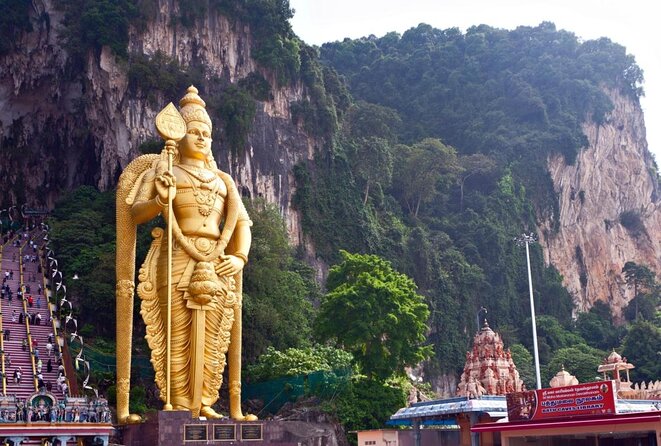
- Climb 272 steps at Batu Caves: See Hindu shrines inside a dramatic cave complex after a scenic drive from central Kuala Lumpur.
- Compare three faith traditions: Visit a Hindu pilgrimage site, a Chinese temple, and the National Mosque in one compact outing.
- Finish among local food and shopping streets: Petaling Street and Brickfields offer a quick look at Chinese, Indian, Malay, and Bangladeshi influences.
- Travel in comfort: Air-conditioned transport, hotel pickup, and drop-off within Kuala Lumpur are included.
- Expect a personal guide: Guides including Jacob, Thiru, Sathesh, and Janar have been praised for clear explanations and flexible service.
- Watch the calendar: The National Mosque cannot be visited by tourists on Fridays, and festival closures can change the plan.
What this four-hour Kuala Lumpur tour is really about
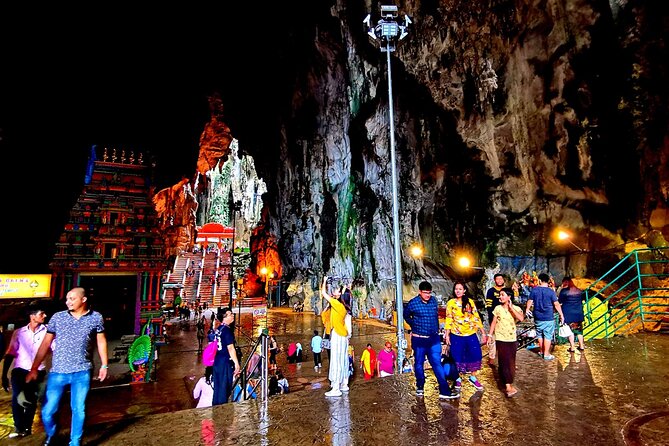
This is not a slow museum tour. It is a brisk introduction to the religious and ethnic mix that gives Kuala Lumpur its character.
You spend about an hour at Batu Caves, then roughly 30 minutes at each of the remaining stops. That timing gives you a useful first look, but it does not leave room for long meals, extended shopping, or a close study of every shrine and building.
The tour works best if you want someone else to handle the driving while you listen and look. Kuala Lumpur’s sights are spread around the city, and the air-conditioned vehicle saves you from piecing together several separate taxi or ride-hailing trips.
The group limit of 15 people is also important. This is not the same as having a private guide, but it should feel more manageable than a large coach excursion. Some bookings may operate as private tours, though that is not guaranteed.
More ways to do Batu Caves:
- Kuala Lumpur: Batu Caves Half-Day Tour with Pick-Up Option
★ 4.5 · 4,288 reviews - Private Half-Day Batu Caves and Cutural Tour in Kuala Lumpur
★ 5.0 · 3,107 reviews - From Kuala Lumpur: Batu Caves Cultural Temple Tour
★ 4.7 · 1,453 reviews
Batu Caves and the climb to Lord Murugan
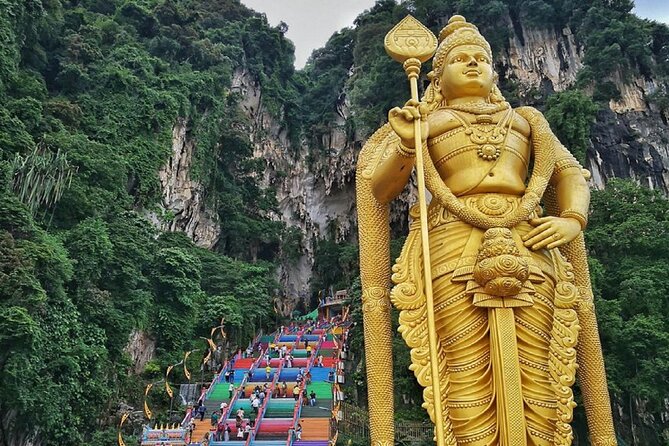
After an approximately 30-minute scenic drive, you reach Batu Caves, one of Malaysia’s most important Hindu religious sites.
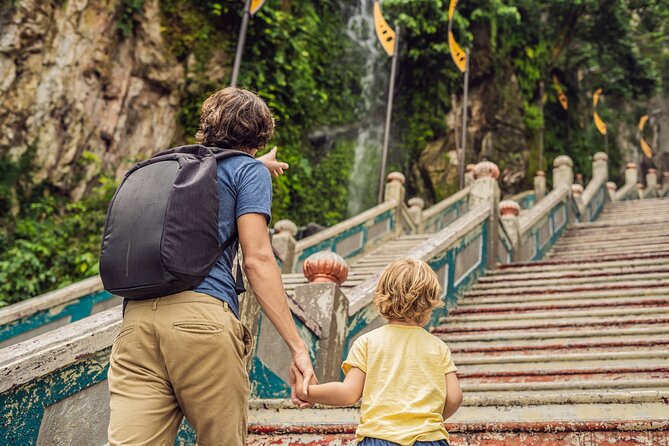
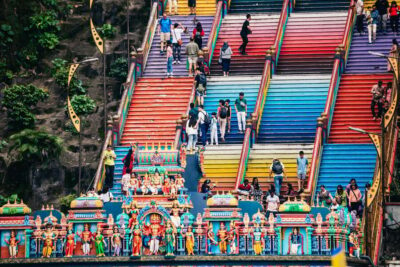
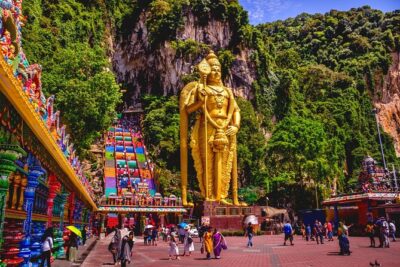
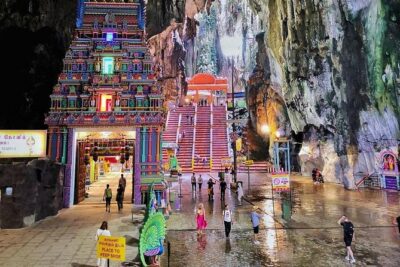
The first sight is the towering golden statue of Lord Murugan at the base of the staircase. From there, you climb 272 steps to the cave temples above. The climb is the physical center of the tour, so take your time and use the landing areas to catch your breath.
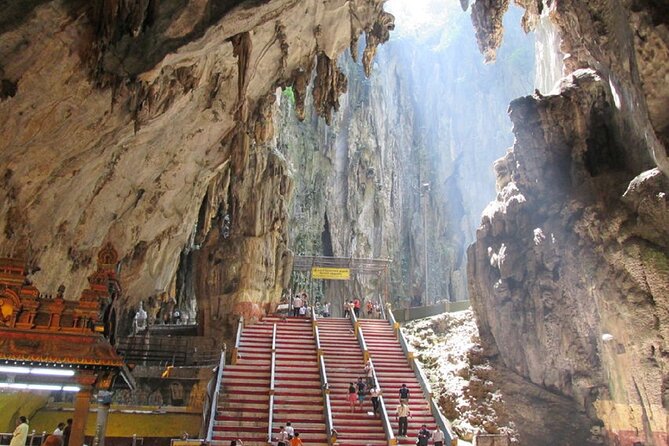
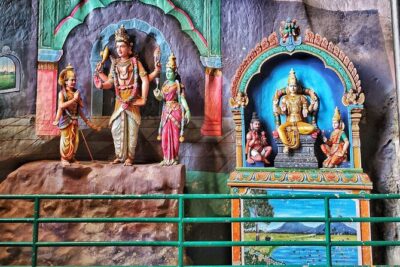
Inside, the setting shifts from city streets to a large natural cave containing Hindu shrines and images of religious deities. Your guide explains the Hindu roots of the nation and provides context for what you are seeing. That explanation matters here. Without it, the caves can become a quick photo stop. With it, you get a clearer idea of why this is a place of worship rather than simply a dramatic attraction.
The one-hour allocation is sensible for a first visit, especially when it includes the climb. Still, you should not expect an unhurried religious study. The time includes getting out of the vehicle, walking to the steps, climbing, seeing the shrines, and returning.
Wear shoes you can walk in comfortably. The tour information confirms the steps, but it does not promise special assistance or a shorter route. Most people can participate, yet anyone with limited mobility should consider whether 272 steps fit their plans.
Religious festivals can also change the mood and pace. One complaint about the experience came from a visit when Batu Caves was crowded with worshippers, making the stop less comfortable. That is not necessarily a flaw in the site or guide, but it is a useful warning: an active pilgrimage day can mean heavier crowds and less room to pause.
Thean Hou Temple and Kuala Lumpur’s Chinese traditions
Thean Hou Temple sits atop Robson Heights and is described as a six-tiered pagoda temple. It was built by Kuala Lumpur’s Hainanese community, completed in 1987, and officially opened in 1989.
The 30-minute stop gives you enough time to see the temple’s main character and listen to its background. It is a good counterpoint to Batu Caves. Instead of a Hindu shrine inside a limestone cave, you see a Chinese temple complex set above the city with its own architectural style and community history.
This is one place where a good guide makes a real difference. Guides such as Jacob and Thiru have been praised for explaining the cultural meaning behind the places rather than simply dropping people off. You should expect an introduction to the temple and time to look around, but not an extended ceremony or a detailed architectural tour.
The schedule can be affected by the calendar. Thean Hou Temple was closed during Chinese New Year celebrations on one reported visit. If your date falls near a major festival, it is sensible to accept that the order or content of the tour may change.
The National Mosque and modern Malaysia
Masjid Negara, Malaysia’s National Mosque, occupies 13 acres of gardens and was designed in the late 1950s. Its architecture was intended to express the aspirations of the newly independent nation.
The visit is brief, around 30 minutes, but it adds an important modern and national layer to the tour. Batu Caves connects you with Hindu worship, while Thean Hou Temple reflects Kuala Lumpur’s Chinese community. The National Mosque shows how Islamic identity is presented at the national level.
The mosque’s broad design and garden setting offer a different visual experience from the earlier stops. Your guide can help connect the building to Malaysia’s development and explain why it carries national importance.
There is one firm scheduling issue: tourists are not allowed to visit the National Mosque on Fridays. If your tour is on Friday, this stop will be skipped. The tour information does not promise a replacement attraction, so book on another day if Masjid Negara is a priority.
More heritage walks around Kuala Lumpur:
- Historical Malacca Guided Day Tour (Shared Tour)
★ 5.0 · 2,172 reviews - Historical Malacca Day Tour from Kuala Lumpur (Private Tour)
★ 5.0 · 515 reviews - From Kuala Lumpur: Private Batu Caves Cultural Tour
★ 4.4 · 410 reviews - Private Half-day Batu Caves and Cultural Tour Kuala Lumpur *2026*
★ 5.0 · 165 reviews
Petaling Street for food and city life
The next stop takes you to Petaling Street in Chinatown. You have about 30 minutes to see a street lined with restaurants and food stalls run by Chinese, Indian, Malay, and Bangladeshi traders.
This is a short taste of Kuala Lumpur’s food culture, not a dedicated food tour. You may see local favorites such as curry noodles and Hokkien dishes, but food and drinks are not included in the price.
That arrangement works well if you want the guide to point out the character of the area while leaving you free to decide what, if anything, to eat. It works less well if you want a full meal. A 30-minute stop is tight for browsing, ordering, eating, and returning to the vehicle, so consider this a preview rather than lunch.
One useful detail from the guiding experience is that Jacob took guests to a South Indian restaurant for lunch. That suggests some guides may offer practical local suggestions or adjust the plan when time allows, but you should not treat a restaurant meal as a guaranteed part of the package.
Brickfields and Little India
The final stop is Brickfields, Kuala Lumpur’s Little India. The area is known for textile shops, jewelry stores, and casual restaurants serving dishes such as dosa pancakes and banana-leaf curries.
It is a fitting finish because it brings the tour back to everyday neighborhood life. After the formal religious sites, you see food, clothing, shopping, and the Indian community’s presence around KL Sentral.
Again, the scheduled time is about 30 minutes. You can get a feel for the area and perhaps note places to return to later, but you will not have much time for serious shopping or a leisurely meal.
If you enjoy food, Brickfields may be one of the most useful stops because it gives you ideas for the rest of your stay. If your main goal is photography or temple architecture, the short visit may feel too quick.
How the guides shape the experience
The strongest part of this tour is likely to be the guide rather than the vehicle or the fixed route.
Jacob is praised for being exceptionally pleasant, professional, and well informed about the locations. He is also credited with showing a more local side of Kuala Lumpur and helping with a South Indian lunch stop.
Thiru is described as highly experienced and especially strong at bringing the tour’s history and culture to life. Another account highlights his kindness and his perspective as a fourth-generation Indian in Malaysia. That kind of personal background can add useful context to Brickfields, Chinatown, and the religious sites.
Sathesh is noted for being informative and accommodating to individual interests. Janar is praised for a friendly manner, clear explanations, and a well-equipped air-conditioned car.
The experience is not guaranteed to include one of these particular guides, but their names give you a sense of the guiding style to hope for: personal, explanatory, and flexible. There is also a less positive possibility. One guest found the driver acted more like a taxi driver, stayed in the car, and gave little explanation at the stops. That makes the guide assignment important.
If your guide does not get out with you or explain the sites, politely ask for more context. The tour’s value depends heavily on interpretation, since the stops themselves are free to enter.
What you get for $40
At $40 per person, the tour offers solid value if you are staying in Kuala Lumpur and want transport, a guide, and a carefully chosen route.
The price includes four hours in an air-conditioned vehicle, an English-speaking driver-guide, hotel pickup and drop-off within Kuala Lumpur City, and all tax and service charges. There are no admission fees listed for the stops, so you are mainly paying for the driving, organization, and guiding.
You are not paying for lunch or drinks. Airport and Port Klang pickup costs extra, which matters if you are arriving with luggage or staying near the cruise port rather than in the city.
I think the price makes the most sense for a first visit, a short stay, or a hot day when you would rather not navigate between five separate areas. It is less compelling if you are comfortable using Grab and prefer to spend an hour or more at each site. One disappointed guest felt that hiring a ride for the same route could be cheaper when the guide did not provide commentary.
The value rises sharply when the guide is active and informative. It falls when the outing becomes only transportation.
Timing, pickup, and group size
The advertised duration is approximately four hours. Hotel pickup and drop-off are available within Kuala Lumpur City, and the transport is air-conditioned.
The route covers a lot of ground, so pickup location and traffic will affect how much time you spend at each stop. The stated schedule adds up to around three hours of visits, with the remaining time used for driving and transfers.
The maximum group size is 15 people. That is small enough for questions to be possible, though the experience may still feel different from a private tour. If your booking becomes a private tour, you may have more flexibility, but that is not something to assume when comparing options.
Confirmation is received at booking. The experience requires a minimum number of participants, and poor weather can lead to a new date or a full refund.
Free cancellation is available up to 24 hours before the start time. Changes or cancellations inside that window are not accepted for a refund.
Who should book this cultural tour?
I would recommend it to you if you want a broad introduction to Kuala Lumpur and prefer an organized half-day to independent transport planning.
It suits first-time visitors, couples, families, and anyone with only a few days in the city. It is also useful for people who want religious and community context rather than a route limited to famous city views.
You should think twice if you dislike stairs, want long visits at each attraction, or mainly want to shop and eat. The Batu Caves climb is not optional in the sense that it is the main reason for visiting, and the market stops are too short for a relaxed meal.
Book on a day other than Friday if the National Mosque matters to you. Also check your dates around major religious and cultural celebrations, since Thean Hou Temple and Batu Caves may be affected by worship and festival activity.
Should you book it?
Book this tour if you want five very different Kuala Lumpur stops in one organized morning or afternoon, with an English-speaking guide and hotel transport included.
Its best feature is the cultural contrast: Hindu shrines at Batu Caves, a Chinese temple on Robson Heights, a national mosque, Chinatown, and Little India. Its weak point is the compressed schedule and the possibility of a driver who provides little commentary.
At $40, it is a fair buy when the guide is engaged and the route saves you the trouble of arranging transport. If you want a slower, more personal visit, consider a private arrangement instead. For a practical first look at Kuala Lumpur’s religious and community life, this half-day route is a useful choice.
FAQ
How long is the Batu Caves cultural tour?
The tour lasts approximately four hours.
Is hotel pickup included?
Yes. Hotel pickup and drop-off are included for hotels within Kuala Lumpur City.
Is pickup from Kuala Lumpur Airport or Port Klang included?
No. Airport and Port Klang pickup are not included and require an additional fee.
How many people can join the tour?
The tour has a maximum group size of 15 people.
Can I visit the National Mosque on a Friday?
No. Tourists are not allowed to visit the National Mosque on Fridays, so the mosque stop will not take place on a Friday tour.
Are food and drinks included?
No. Food and drinks are not included. The tour visits Petaling Street and Little India, where you can find restaurants and food stalls.
Can I cancel for a full refund?
Yes, if you cancel at least 24 hours before the experience start time. Cancellations made less than 24 hours in advance are not refunded.
Just added around Kuala Lumpur
- Sunway Lagoon Ticket (One Day Pass)★ 3.5 · 5 reviews
- Transit Tour Private Tour (Ex Port Klang Cruise Centre/KLIA 1 &2)★ 5.0 · 10 reviews
- Kuala Lumpur City & Batu Caves Temple Private Tour★ 4.5 · 3 reviews
- Private Port Klang Cruise to Kuala Lumpur City Tour★ 5.0 · 3 reviews
- Genting SkyWorlds Theme Park Tickets (Optional)★ 5.0 · 5 reviews
- Full Day Melaka Private Tour from Kuala Lumpur★ 4.0 · 5 reviews
- Kuala Lumpur International Airport Transfers★ 5.0 · 4 reviews
- Kuala Lumpur Airport To Kuala Lumpur City Hotels★ 4.5 · 8 reviews
Batu Caves Tours from Kuala Lumpur, compared.
Private Half-Day Batu Caves and Cutural Tour in Kuala Lumpur
Read our review →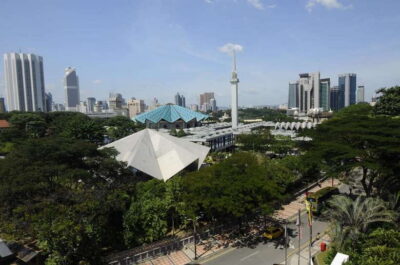
Genting Highland & Batu Cave Guided Day Tour (SIC/Shared Tour)
Read our review →
Private Tour Kuala Lumpur with Petronas Twin Towers Observation Deck & Batu Cave
Read our review →
Kuala Lumpur Suburbs Batu Caves Half-Day Tour (SIC/Shared Tour)
Read our review →Browse the lists this tour appears in